
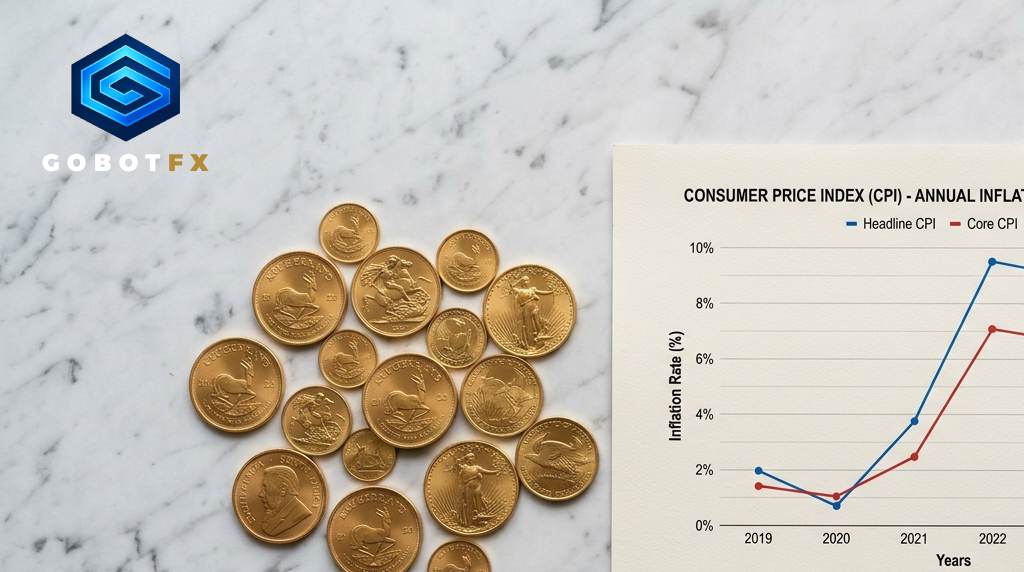
July 14, 2026 — US June CPI Report Analysis
The Headline Numbers
The US Bureau of Labor Statistics released June 2026 inflation data on Tuesday, and at first glance it looked like a clean disinflation story:
| Metric | Actual | Forecast | Prior |
|---|---|---|---|
| Core CPI m/m | 0.0% | 0.2% | 0.2% |
| Core CPI y/y | 2.6% | 2.9% | 2.9% |
| CPI m/m | -0.4% | -0.1% | 0.5% |
| CPI y/y | 3.5% | 3.8% | 4.2% |
Every single print came in below consensus. Standard market wisdom says: soft inflation → less pressure on the Fed → dollar strengthens → gold, a non-yielding asset priced in dollars, weakens.
That is not what happened.
What Actually Happened
Gold didn’t fall — it rallied more than 2%, pushing spot prices back above $4,000/oz and futures toward $4,100. The simple “soft CPI = weaker gold” formula broke down completely. Understanding why is more instructive than the headline itself.
Three Forces the Simple Formula Ignores
1. Gold trades on real yields, not headline inflation. Gold is a non-yielding asset. What matters isn’t inflation in isolation — it’s inflation relative to what the market expects the Fed to do with interest rates. Lower-than-expected CPI reduces the odds of further rate hikes, which pulls down real (inflation-adjusted) Treasury yields. Lower real yields reduce the opportunity cost of holding a zero-yield asset like gold, making it more attractive — not less.
2. Geopolitics was already the dominant driver. Going into the CPI release, gold had already dropped over 3% in a single session as the US reinstated a naval blockade on Iranian shipping and Iran declared the Strait of Hormuz closed. Renewed US-Iran hostilities had oil prices climbing and safe-haven demand building. The CPI release landed on top of an already oversold, geopolitically-stressed gold market — so a softer print acted as relief, not as a fresh reason to sell.
3. The dollar didn’t behave as the formula predicted either. The textbook logic assumes soft inflation is dollar-bullish. In practice, softer inflation data typically eases pressure on the Fed to keep hiking, which is usually dollar-bearish, not bullish, since it lowers the interest-rate differential that attracts capital into USD assets. The dollar’s rally over the prior two sessions had been driven almost entirely by risk-aversion flows tied to the Middle East conflict — a very different mechanism than “strong economy, strong dollar.”
The Bigger Picture: A Head-Fake Headline
Several analysts flagged in advance that June’s CPI report would look deceptively soft. The monthly decline was driven almost entirely by a temporary drop in energy prices tied to a mid-June ceasefire — not a broad-based cooling of price pressures. Core CPI’s deceleration to 2.6% is genuine good news, but it arrives at a moment when:
- The US-Iran ceasefire has already collapsed, with fresh strikes reported in the days immediately following the report
- Oil prices are climbing again on renewed Strait of Hormuz risk
- July’s energy readings are widely expected to reverse the June dip
In other words, the report may represent a one-month statistical air pocket rather than a durable trend. The structural forces holding core inflation elevated — sticky shelter costs and services inflation — remain fully intact.
Takeaways for Traders and Investors
- Don’t apply mechanical rules to gold. “Weak data = weak gold” only holds when gold’s price action isn’t already being driven by a stronger force — in this case, geopolitical risk and positioning extremes.
- Watch real yields and the DXY directly, rather than inferring their direction from a single data print.
- Treat single-month CPI prints with caution when they’re distorted by an unusually volatile energy component. The Fed’s own commentary continues to emphasize core, trend-based measures over one-off readings.
- Geopolitical risk premium can override monetary logic in the short run. Traders positioning purely off the economic calendar risk being blindsided by headlines from the Strait of Hormuz.
This analysis is for informational purposes only and does not constitute investment advice.